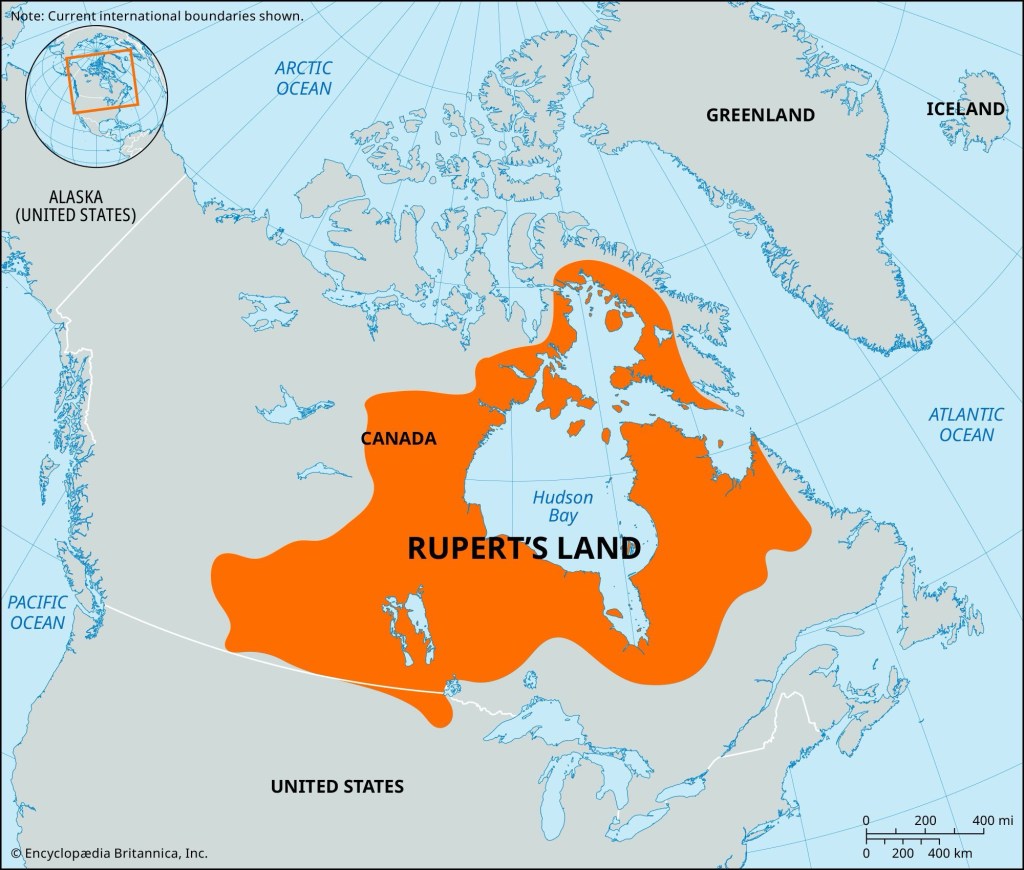
One of the British North American colonies is usually forgotten about. It had a very small population, it was remote, it was closed off much of the year because of winter ice. It was huge, larger than the whole United States east of the Mississippi River.
It was Rupert’s Land.
You never heard of it. So who was Rupert and where was Rupert’s Land?
Rupert was a prince, a first cousin of the English king Charles II (r. 1660-1685). He was a cavalry commander during the English Civil War. It all began with two French fur traders, who wanted France to set up a trading post in the remote Hudson’s Bay region of what is now Canada. The two knew that the huge region was full of fur-bearing animals, including beaver, and beaver pelts were the gold of New France.
The French authorities in New France were not interested. New France was concentrated along the St. Lawrence River andthe Great Lakes country, and to the west. So the two, Pierre-Esprit Raddison and Medard Chouart sailed to England with a plan and tried to interest merchants. Someone came up with the idea of a trading company, and the idea grew. It was called the Hudson’s Bay Company (HBC for short) and needed some influential endorsements to kick start it. Prince Rupert signed on, becoming the Company’s first governor, although it was in name only. Rupert was an influential man, so his endorsement was important. As a result, king Charles gave the HBC a charter in 1670, granting the company administrative power over the all the country through which rivers flowed into Hudson’s Bay. It turned out to be more than a million square miles.
Hudson’s Bay is a very large bay in northern Canada. It takes its name from Henry Hudson, the same Hudson for whom New York’s Hudson River is named. Hudson was an explorer, variously employed by the English and the Dutch. He was searching for the Northwest Passage in 1610-11 when he discovered the Bay. It was hoped that a passage to Asia was possible by going to the north of North America, which would have been a much shorter voyage than reaching Asia by rounding Cape Horn or the Cape of Good Hope. Hudson was last seen in a small boat, cast adrift in the Bay by a mutiny on his ship.
The Hudson’s Bay Company set up a fort on the Bay, andalso set up a network of small and regional posts. Furs were brought to the small posts, transported to larger posts and then by canoe to the main post. Furs were shipped by sea to Britain and Europe, and goods were imported the same way. HBC provided a wide range of goods, from blankets and kettles to traps, axes, muskets and gunpowder.
The trappers were a mixed group, including French, mixed race, English and trappers from all the northern indigenous tribes (today Canada calls them the First Nations and the Metis). Many of the HBC traders and officials were Scots. Furs were a result of the very severe winter climate, because many animal species grew thick, lush coats to survive the extremely cold winters. HBC traded in many kinds of firs, including martin, squirrel, fox, wolf and others, but especially beaver. A characteristic of beaver fur was that it was easily felted and converted into high quality hats. Beaver had been almost completely wiped out in Britain, Scandinavia and Russia, and American beaver was a new source.
HBC was the primary European factor in Rupert’s Land. The savage wars between the French and British periodically devastated the frontier between the English colonies and New France, but had little effect on Rupert’s land, which was too remote and too thinly populated. In the late 1700s and early 1800s competition developed with fur companies based in the United States, especially that of John Jacob Astor, who was interested in the Oregon country. His ships reached around Cape Horn and set up trading posts, most notably one at Astoria, Oregon. Astor’s ships could take furs obtained there on to China, where the furs were highly valued. The HBC’s response was a trapping blitz, wiping out the beaver in the Oregon country so the Americans would give up. The War of 1812 ended Astor’s plan, and he switched to New York real estate, in the process becoming an exceedingly rich man.
With the 1800s came the decline of the long fashion for the beaver hat. HBC continued to trade in furs, but the spectacular profits of the early days were no longer possible. HBC also functioned as the eyes and ears of the British in the far northwest.
By the middle 1800s, the various Canadian provinces were ready for self-rule. The British set up the independent Dominion od Canada in 1867. Rupert’s Land was not part of the federation. HBC was interested in getting out of the business of administration and was considering offering it for sale.
The United States was interested, having just bought Russian America (Alaska). The purchaseof Rupert’s Land would have added a million square miles to the U.S., including much of northern Quebec, some of Nunavut, and almost all of the prairie provinces of Manitoba, Alberta and Saskatchewan. Britain intervened and forced HBC to sell the land to the Canadian Federation in 1867, for the equivalent of $1.5 million.
Deep knowledge,everyday.
Like,comment and follow : Greg’s Business History.
Happy Reading.
Thanks


 Greg's Business History
Leave a comment