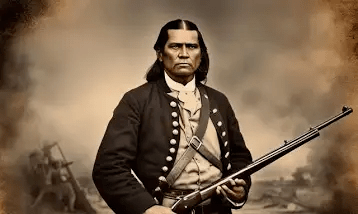
The last Confederate general to surrender in the American Civil War did so on June 23, 1865. He was brigadier general Stand Watie, a member of the Cherokee tribe. Watie’s story is remarkable.
He was born in the ancient Cherokee homeland in the mountains in Georgia. The Cherokee were a powerful tribe, considered one of the “Five Civilized Tribes.” Those were indigenous American peoples in what is now the Southeastern United States that had adopted settler ways, including farming, plantations, slavery and Christianity. They were the Cherokee, Chickasaw, Choctaw, Creek and Seminole. The Cherokee formed what was essentially a kind of republic, with a constitution modeled on the American one.
Being considered “civilized” wasn’t very useful. These five indigenous peoples occupied tens of thousands of square miles of excellent land. Settlers wanted that land. A gold rush in Georgia in 1820 brought in thousands of prospectors who trampled Cherokee crops and paid no attention to Cherokee ownership. Stand Watie’s family was prosperous, much like any other Georgia plantation family—except they weren’t white. In the 1820s the state of Georgia decided to get rid of all its Indian inhabitants. In effect the state put Cherokee land up for sale through a lottery. The Cherokee appealed all the way to the Supreme Court and won their case. President Andrew Jackson, who was a Tennessean and one of the country’s best soldiers, famously said that the Chief Justice had made his decision, not let’s see him enforce it.
The writing was on the wall. The Cherokee knew that they were going to lose their land, There were tens of thousands of settlers flooding into Cherokee country. A group of Cherokee leaders, including Watie, decided to negotiate with the federal government. They signed the Treaty of New Echota in 1835 and agreed to emigrate to Indian Territory west of the Mississippi River (Indian Territory eventually became the state of Oklahoma). In the treaty the Cherokee agreed to give up their land in return for lands in the Territory and annual payments to the tribe for a set number of years.
The tribe split over the treaty. Some of them, like Watie, migrated to the Territory in 1835. The tribal council declared the death penalty for any Cherokee involved in alienating the tribe’s ancestral land. In 1838 the U.S. Army rounded up the resisting Cherokee, and sent them under guard to Indian Territory, by wagon, steamboat and foot. About 16,000 people were involved and about 4,000 of them died, a time of agony for the Cherokee that has since been called the Trail of Tears. Today it would be called ethnic cleansing. A few managed to avoid the Army’s dragnet and hid away deep in the rugged Smoky Mountains, where their descendants live today. Eventually most of the Five Tribes were removed to Oklahoma, involving somewhere between 60,000 and 100,000 people (numbers are guesswork).
In Indian Territory, each of the “Five Civilized Tribes” was given its own land and formed an “Indian nation.” They had self-rule. In the Cherokee Nation, there was something close to anarchy as the men who had signed the treaty were hunted down and killed. Watie was one of the few signers of the treaty who managed to avoid assassination.
Eventually things calmed. In the 1850s the Cherokee territory became modestly prosperous. Watie developed a profitable plantation and owned more than a hundred slaves.There were perhaps 6,000 slaves in Indian Territory and a total population of about 100,000.
Slavery was a divisive issue that affected Indian Territory as well as the rest of the nation. The Cherokee were badly split on the issue, with Principal Chief John Ross opposing slavery and a faction of the tribe led by Watie that was pro-slavery. When the Civil War began, the Confederates signed treaties of alliance with each of the Five Tribes, guaranteeing their right to own slaves and committing to allowing the tribes to continue self-rule. The John Ross faction supported the Union and retreated to Union territory in Kansas and Missouri,
Stand Watie joined the Confederate army in 1861. He recruited a Cherokee regiment of mounted riflemen that was eventually designated the First Cherokee Mounted Rifles, and he was given the rank of colonel. There were several Indian regiments in both armies, with something like 3,500 serving the Confederacy and an equal number serving in Union ranks. The Indian troops were used mostly as skirmishers and raiders. Law and order collapsed in the Territory, as it did in adjacent parts of Arkansas, Missouri and Kansas.
Watie’s regiment took part in the battles of Pea Ridge and Wilson’s Creek. Battles west of the Mississippi were considerably smaller than the savage and bloody battles in the east like Antietam and Gettysburg, but they were still hard fought. Watie’s regiment fought in 27 different battles and many skirmishes. His highly mobile troops raided Union supply lines. One of the most colorful incidents came in July of 1864 when Watie’s troopers ambushed and captured a Union river steamboat, the J. R. Williams. It’s sometimes jokingly considered the only naval battle to ever take place in land-locked Oklahoma. They captured large supplies of food, which led to many of the soldiers heading home with all the food they could stuff in their saddlebags, supplies for their hungry families.
Another exploit came in September, when Watie’s troopers captured a large union supply wagon train after defeating its guards. The wagons yielded large supplies of food, weapons and other goods. Food and supplies were hard to come by in 1864 in Indian Territory.
An ugly incident occurred in September 1864, when his troops found a large party of Union soldiers cutting hay in a field to supply horses, The harvesters in the field were from a Kansas U.S. Colored Troops unit, and Watie’s men massacred many of them, in what came to be called the Hay Meadow Fight. There were several other incidents of USCT soldiers being massacred or killed after surrendering, but this was the only one Watie’s regiment was involved in.
Toward the end of the war, most of Indian Territory was a no-man’s land, home to a number of guerilla bands. Two were known for exceptional brutality, one headed by “Bloody Bill” Anderson and another by William Quantrill. Both were nominally Confederate units. Anderson’s fighters became notorious for capturing a train, and finding it full of wounded Union soldiers, killing them. They then ambushed a unit of Union troops sent after them, killing more than a hundred. Quantrill’s unit was responsible for the raid on Lawrence, Kansas, in which about 180 men and boys were lined up and murdered. Members of Quantrill’s raiders included Frank and Jesse James, later famous criminals in the West.
Late in 1864, Stand Watie was put in charge of all Confederate units in Indian Territory. He had a reputation for personal courage and as an aggressive and talented commander. He was promoted to brigadier general. His courage and ability could not do anything to prevent the collapse of the Confederacy. His troops continued to campaign until after the April surrender of Lee’s army in Virginia. He remained in uniform until June of 1865.
Watie was the only Native American general in the Civil War.
After the war, he returned to his plantation. Union authorities imposed a peace treaty on the Cherokee factions that involved freeing their slaves and agreeing to not prosecute each other for offenses committed during the war. Casualties in Indian Territory had been heavy, perhaps 10% of the total population.
Deep knowledge,everyday.
Like,comment and follow : Greg’s Business History.
Happy Reading.
Thanks


 Greg's Business History
Leave a comment