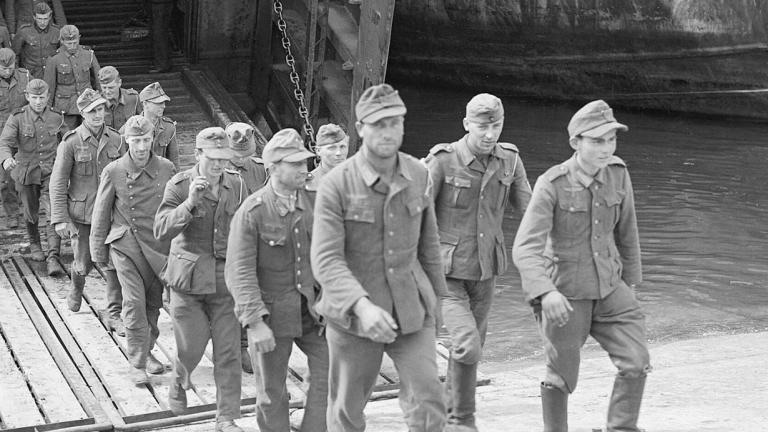
During World War Two there were some remarkable escapes by prisoners of war (usually abbreviated to POW), and movies have been made about them. By far the best known is the one by more than 70 Allied pilots and aircrew, who tunneled out of the German Stalag Luft III in March of 1944. That escape earned the name “The Great Escape,” and became something of a legend.
There was a German who escaped capture during a German defeat, and crossed parts of three continents, was captured and then became the only POW ever to escape from the island of Great Britain in either world war. The man was named Gunther Pluschow (1888-1931), a naval aviator.
In 1914, Pluschow was stationed in China, hardly a place associated with World War I. Germany had forced China to lease a bay and a portion of the Chinese mainland called Tsingtao (also known as Qingdao). The Germans built a German-style town there and built a naval base for their East Asia Squadron. Germany had also bought a number of islands from Spain at the end of the Spanish-American War, including the Caroline Islands, the Palau Islands and the Northern Marianas (except for Guam, which was taken by the United States). Japan joined the Allies in 1914 and promptly took control of these islands; Australia and New Zealand took control of the rest of the German colonies in the Pacific, including Papua and German Samoa. But Tsingtao was a harder nut to crack, and that’s where Pluschow was stationed.
The siege of Tsingtao was by far the largest military operation of World War I in the Pacific. Japan landed about 20,000 troops and established a naval blockade. There was a small British force of 1,500 men also involved, which included both troops from Britain and some Sikh troops from the Indian Army. Tsingtao was defended by about 4,000 German troops, some sailors and a few Austrians from an old Austrian warship. A few German civilians also joined the defense. The battle pitted Germans and Austrians against Japanese, Englishmen and Sikhs on Chinese territory,
The German East Asia Squadron would have been no match for the Japanese fleet, and hastily departed for South America, hoping to round Cape Horn and make it back to home waters. It encountered and sank a British force at the Battle of Coronel off the Chilean coast and was itself sunk in another battle with a British squadron in a battle near the Falkland Islands.
Pluschow piloted a Taube, an early monoplane (which means having one wing, unlike the biplanes most typical of the war), apparently the only German aircraft in the battle. He flew observation missions, and on one of them shot down a Japanese plane by using his pistol and shooting the pilot—fighter aircraft had not yet emerged. It was probably the first aircraft shot down in war in all of Asia.
It became obvious that Tsingtao was going to fall to the Japanese, so Pluschow was ordered to fly as far as he could from the city and escape. The story is that he was carrying documents and records, but whether he actually did so is unclear. He did escape, flying his flimsy aircraft a remarkable 250 kilometers into China’s interior. He took a train to Shanghai. China was neutral in the war, and a European traveling by train would have been uncommon but accepted, because various Europeans (and Amercans) had concessions in China, and a number had been hired as technical experts by various Chinese factions. China had overthrown the Qing (Manchu) dynasty in 1911 and was divided among the territories of competing war lords. Shanghai was in effect ruled by foreigners, so once he reached the city, Pluschow was able to find a friend who bought fake Swiss documents for him.
Then Pluschow decided to take ship for San Francisco. He bought a ticket and reached San Francisco by way of Nagasaki and Honolulu. He somehow escaped the attention of the Japanese authorities, who would have arrested him and added him to the collection of German and Austrian POWs held in Japan.
Once in the United States, he took a train to New York City, where he got in contact with German sympathizers (the U.S. was neutral until it joined the Allies in 1917). They provided him with fake documents and money which he used to buy a ticket on a ship for Europe.
The ship docked at Gibraltar in Spain, then (and still) controlled by the British, and in 1914 a major British naval base. His identity was discovered, and he was arrested as a POW. Pluschow was taken to Britain and imprisoned at a place called Donington Hall, which was reserved for captured German officers. It was a country estate that had been requisitioned by the government.
Imprisonment at Dunnington Hall was not particularly arduous. In that era, officers were treated far better than enlisted men. The German government arranged for each officer to receive a weekly small stipend for expenses, set up through the Swiss embassy. Dinner was held with silver service, and there was even a wine list. Nonetheless, it was a military prison and in two wars, only one man escaped. There were several escapes by German officers, but all were recaptured. Except one.
On July 4th, 1915, Pluschow climbed over two high barbed wire fences, somehow evading guards and the searchlights. He walked into town, probably helped by his being fluent in English, and caught a train to London. Once there, he scoured the docks, hoping to find a ship bound for the neutral Netherlands. He used some kind of dye to turn his blonde hair black and found dingy clothes so he could pass as a dock worker. To pass the time, he read books at a public library and hid at night in the British Museum.
After three weeks, he finally sneaked aboard a Dutch ship, hiding in a covered lifeboat, and made it to the town of Flushing. His luck held and he got through Dutch customs undetected. Had he been identified, he would have been interned in the Netherlands for the duration of the war. He walked to the German border, where at first, he was thought to be a spy. Once he was identified he became immediately famous, and became a hero to the public, including being awarded the Iron Cross, first class, by Kaiser Wilhem himself (“kaiser” was Germany’s constitutional monarch; the word itself is similar to “tsar”).
Pluschhow wrote a best-selling book about his exploits. His remarkable escape was a real positive boost for the Germans, as the war ground on with no victory in sight. He married in 1916, had a son in 1918 and survived combat.
Pluschow escaped prison and survived the war, but he did not escape the fact that aviation was extremely dangerous, After the war, he became an aviator and explorer in South America. He was surveying a glacier from the air in Patagonia in 1931, when his plane crashed, killing him.
Deep knowledge,everyday.
Like,comment and follow : Greg’s Business History.
Happy Reading.
Thanks


 Greg's Business History
Leave a comment