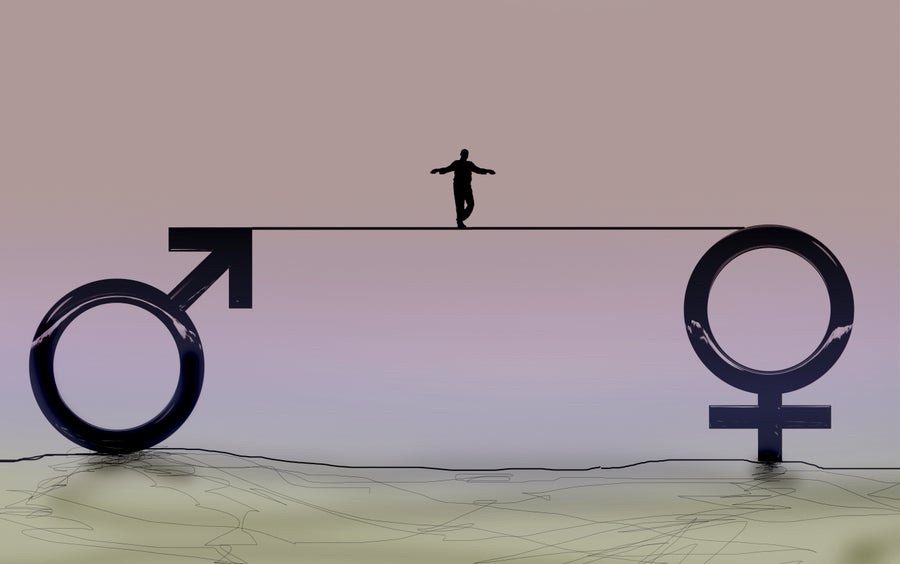
There is a great deal of debate these days about the nature of gender. In my country, the United State, the newly elected president has issued a decree (called an Executive Order) that there are only two sexes, assigned at birth.
What I write here is not to say that one way is better or worse than any other, but to make a point that exceptions to the notion that people are either men or women from birth are widespread and go back many centuries.
There’s a problem with that concept: it’s not very accurate. For one thing, a small percentage of people are born with indeterminate sexual identity—partly male and partly female,and termed “intersex.” In classical Greece, such people were called hermaphrodites, one of the Greek pantheon of gods and the son of Hermes and Aphrodite, and a myth explains it. More recently, intersex people were killed as witches, honored as seers, and near our own time, exhibited as freaks in circus sideshows.
Birth also sometimes features some form of conjoined twins, such as two heads and torsos, one pelvic region and two legs. What sex are two conjoined people with one set of organs? Or what of a person born with no sexual organs? These things are rare but show that the “either one or the other” concept has some defects.
And sometimes conjoined twins had families. Chang and Eng Bunker, the original “Siamese Twins” were born in Thailand in 1811. They were exhibited as freaks but at age 21 took control and exhibited themselves, making good money. They settled on a plantation in North Carolina, married sisters and had 21 children (they died in 1874).
There’s another aspect, which is the kind of sexual attraction people feel. Most man prefer women, and most women prefer men. But some men prefer men and some women prefer women. And some men like both and some women like both. And some like neither. That’s eight choices.
The claim that we are either male or female usually asserts that marriage is between one man and one woman, However, there are cultures in which a man may have four or more wives, and a few where a woman may have several husbands. And, in times past, rulers such as emperors and pashas and kings had one primary wife and literally hundreds of concubines, and such a man might have a hundred or more children—and be seen as perfectly normal in the society concerned. King Solomon is one of the famed figures in the Bible, had seven hundred wives and three hundred concubines.
While modern trans people often have surgery and hormone therapy as they transition from man to woman or woman to man (this goes back about a century, starting in Germany), many cultures have created roles for women who wanted to live as men and men who wanted to live as women. This is sometimes described as a “two spirit” phenomenon, but that’s something of an oversimplification.
Examples include a number of American Indian tribes.There is a Lakota term for a man who wished to become a woman. The Blackfoot people acknowledged a “manly hearted woman,” a woman who lived as a man. The Ojibwe had a concept of half-man/ half woman. The Cherokee had terms roughly meaning other spirited. The concept of gender choices that were more complicated than the European either male or female was widespread among the indigenous American peoples. Sometimes women lived as men, and led war parties on raids against enemies, and a few are known to have become war chiefs. Sometimes men lived as women, doing women’s work and living as wives. And some women living as men had other women as wives.
There are plenty of other examples when a particular culture constructed an acceptable role for people whose gender choices differed, Some are surprising. In Albania, there was a phenomenon called “sworn virgins,” women who swore a vow of chastity and who dressed and men. And in Naples, there was a group of men called femminiello, who dressed as women and assumed women’s roles—it may have gone back to the days of the Roman empire. Variations are known to have existed in Turkey, Nigeria, Russia, India, the Philippines and among indigenous people in Polynesia.
And how do we categorize groups that voluntarily abandon sexuality? The Shaker sect in the US (a variation on the Quakers) did not believe in marriage and did not believe in sexual activity. Men and women lived complementary lives in dormitories, and prospered for generations, recruiting new members of adopting orphans (they gave the orphans the option of leaving once they reached adulthood). And a Russian sect believed that men’s testicles and women’s breasts were evil, derived from half of the apple that Eve ate in the Garden of Eden. So they amputated breasts and castrated male children. Both sects are now extinct, but for participants, their culture worked.
That humans are naturally either male or female from birth is shown not to be true by intersexuality, birth with gender physiology that is both male and female. But in cultural terms, alternative genders have been created and used in a large number of cultures all around the world and for a very long time.
Deep knowledge,everyday.
Like,comment and follow : Greg’s Business History.
Happy Reading.
Thanks.


 Greg's Business History
Leave a comment