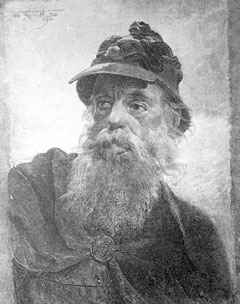
History is full of stories. I’m an avid reader about American history, and I recently came across a story that I find fascinating. It’s the story of a man who became a French baron, and who lived decades with an Indian tribe in Maine, becoming a chief of the Abenaki people.
Jean-Vincent de St. Castin was born in 1652, in Bearn, in the southwest of France, the third child and second son of a baron. In 1654 his father had been proclaimed Baron St. Castin by Louis XIV, the French king. As the second son, he would not inherit either the estate or the title, so at 13 he became a cadet in a French regiment. Younger sons of the aristocracy usually joined the church or the military.
New France (roughly what is now the province of Quebec in modern Canada) was enduring debilitating attacks by the Iroquois, so Louis XIV sent the Carignan-Salieres regiment to New France and St. Castin went with it. He was thirteen when he arrived in Quebec in 1665 and he would not return to France until 1701.
At the time St. Castin reached New France, there was a conflict between new Egland and New France over the borderlands between them. Much of the contested region was in what the French called Acadia, which included much of modern Maine and adjacent Nova Scotia.
He attracted the attention and confidence of his superiors, and at age 18 was art of a group of 30 soldiers sent to repair a small fort near the modern town of Castine in Maine. The small garrison was withdrawn to Port Royal (now Annapolis Royal in Nova Scotia). St. Castine stayed behind and during 1671-1672 familiarized himself with the region, canoeing along the Maine coast and rivers, and traveling overland as well. He developed close ties with the Abenakis, learning their dialect of Algonquian.
In 1674, the small fort was reoccupied, again with 30 soldiers, commanded by a Lieutenant de Chambly. The Dutch and English had recently allied in a war against France, but England had made peace. A Dutch privateer, the Flying Horse,descended on the small fort and captured the tiny French garrison. The privateer carried the captives to Boston, but little is known of what happened there. Somehow, he made an escape.What is known is that St. Castin arrived in Quebec with some kind of note asking for a ransom for de Chambly. The authorities in Quebec City were impressed by his long journey through the wilderness. The ransom for Chambly was 1,000 beaver skins, which was paid. Chambly was released and moved on when he was appointed governor of Martinique in the Caribbean.
St. Castin became the third baron de St. Castin in 1674, on the death of his brother, the second baron. His sister and her husband took control of the barony’s estate. St. Castin was formally a baron during his many years of living amid theWabanaki in present day Maine (the Wabanaki were an alliance of four tribes, including the Abenaki tribe).
A key factor in St. Castin’s life was his relationship with Madockawando, a paramount sachem (a sachem was a hereditary chief) of the Penobscot group of the Abenaki people, who led his people for fifty years. He was impressed by and fond of the young baron. Most of the Wabanaki people were allied with new France, and many converted to Catholicism.
St. Castin married one of the sachem’s daughters about 1674. Her Christian name was Marie-Mathilde, and her Algonquian name was Pidicwanniskwe. They had at least two sons, who were sent to Quebec for schooling. They also had several daughters.
St. Castin built a trading post which included his house, a warehouse and other structures. It became a focal point of trade, including trading for the valuable beaver pelts, and also became a center for supplying Indians with a variety of goods. He became in effect a French Indian agent. In summer, Penobscotscamped there to exploit fish and shellfish, after planting their fields with corn, beans and squash (they returned to their fieldsin the fall).
In southern New England in 1675, a brutal war broke out, led by a Wampanoag sachem the colonists called King Philip.After severe fighting in which more than a thousand colonists were killed, the English won. Sizable numbers of Indians fled east and north, hoping to find refuge with various Abenaki bands.
Fighting broke out in Maine following a bizarre incident in which several English sailors came across a canoe carrying the wife and son of a sachem named Squando. They tossed the baby into the water to see if it was true that Indian babies could swim as infants. The child’s mother saved the infant, but he died soon after. In revenge, the Saco and Androscoggin Abenaki bands attacked settlements.
Madockawando did not join the fighting until August 1676, and it is not known if St. Castin participated, but he very likely advised his father-in-law. The fighting was still somewhat limited until another incident in September of 1676. A local leader named Richard Waldron in Dover, New Hampshire, invited hundreds of Indians to a supposed peace parley that was to begin with a mock battle followed by a feast. About 400 people from a variety of tribes gathered expecting a feast. The mock battle was an ambush: the Indians were surrounded and captured. Waldron let half of them go but detained 200 who were sold into slavery. The Abenaki alliance began devastating raids, destroying many of the settlements along the Maine coast.It ended in 1678 with a truce.
Another war broke out in 1688 between the English and Abenakis, It was locally called ‘St. Castin’s War” because he was the principal French influence among the Abenaki tribes and New Englanders saw him as the bogeyman behind the Indian raids.
The war in its wider phase became known in the colonies as King William’s War, named after the English king. In Europe the conflict was called the Nine Year’s War (1688-1699), during which a coalition fought against Louis XIV’s France. In the colonies, the fighting was mostly a matter of the French fighting the Iroquois and the English fighting the Abenaki.
In 1689, the Abenaki raided Dover, New Hampshire, killing 29 of the English and capturing 28. Richard Waldron, architect of the 1676 incident that enslaved 200 Indians, was captured and tortured to death. Raids continued on and off, such as the Candlemas Massacre in February of 1692, when a raid killed 50 English and took 100 more captive. It is not known if St. Castin was involved in either, although it seems likely.
St. Castin‘s actual participation in the war is not well known. His influence on the tribes was substantial and he probably advised them. His best documented military action wasin 1696 when he led a force of some 200 Abenaki and 50 Mi’kmacs on the raid against Pemaquid (near what is now Bristol, Maine) an English fort and trading center. The attacking force may have been the largest of the war, with 500 to 600 Indians and a hundred French troops. The English surrendered.
The degree of importance the English attached to St. Castinis evident from an elaborate plot to assassinate him. Two French deserters who had been taken to Boston either proposed the murder or were recruited to do so. They were joined by two captured Acadian sailors. All four were then sent to Penobscot Bay, just how unclear. The two Acadians overpowered the two deserters and turned them over to French authorities. The two confessed and were executed.
St. Castin and his Abenaki baroness returned to France in 1701. He had two purposes. One was to reclaim his barony, which had been taken over by his brother-in-law, and to clear his name. There had been claims in New France that St. Castin had traded with the English, that he had more than one wife and other rumors.
He became bogged down in lawsuits filed by Jean de Labaig, his lawyer brother-in-law. Labaig had made himself executor of the estate years. Labaig’s skill as a lawyer prevented St. Castin from recovering his estate, and on his death in 1705, St. Castin’s oldest son in Maine became the fourth baron. When it became evident in 1704 that the baron was not returning, the Governor of New France recruited Jean-Vincent’s oldest son, Bernard-Anselme, a 15-year-old student in Quebec. Bernard-Anselme inherited his father’s influence with the Abenaki andalso became the fourth baron St. Castin after his father’s death.
The best-known of Bernard-Anselme’s exploits is during June of 1707, having been appointed an ensign, led 80 Abenaki warriors in an action that resulted in 800 British militia withdrawing and returning to Boston.
In 1710, France ceded Acadia (now called Nova Scotia) to Britain. While he was a competent officer, he never adapted Abenaki ways as his father had. And just as his father had done, in 1714 he and his wife left for France to try to assert control over the family estate. All that resulted was more contention and he never managed to recover the family land. He died in 1720).
St. Castin’s other son, Joseph, also emerged as a competent leader. One historian asserts that Joseph was made “great chief” of the Abenaki.. He was captured by the British in 1721 and imprisoned for a time in Boston. He was released because his capture was deemed illegal. Joseph remained with the Abenakifor most of the rest of his life.
Deep knowledge,everyday.
Like,comment and follow : Greg’s Business History.
Happy Reading.
Thanks


 Greg's Business History
Leave a comment